
Emergency Gate Repair Near Me: What Norfolk Homeowners Should Do First
If your gate has stopped working, the first thing to do is decide which is worse right now: a gate stuck open, or a gate stuck closed with a vehicle trapped. Those are two different emergencies with two different responses. Get the sequence right in the first few minutes and you stay secure until a technician reaches you. Get it wrong, and you can turn a control-board fault into a bent swing arm or a gate off its track. Here’s the order we’d walk any Norfolk homeowner through if they’d rather not figure it out alone: call (844) 410-6351.
Stuck Open or Stuck Closed? The First Decision
An open gate is a security problem you can usually manage on your own. A closed gate with a car boxed in, or with someone caught in the path, is a safety problem and needs a different approach.
If the gate is stuck open:
- Keep everyone, pets included, away from the moving panels while you figure out whether power is still live to the operator.
- Engage the manual release only after the operator has stopped. Never force it while the motor is trying to run.
- Once the gate is parked, use the manual release to lock the leaves in the closed position if the hardware allows it.
- If it won’t lock, add a temporary physical deterrent: a chain and padlock through the gate frame and a fixed post, or a vehicle parked across the opening overnight.
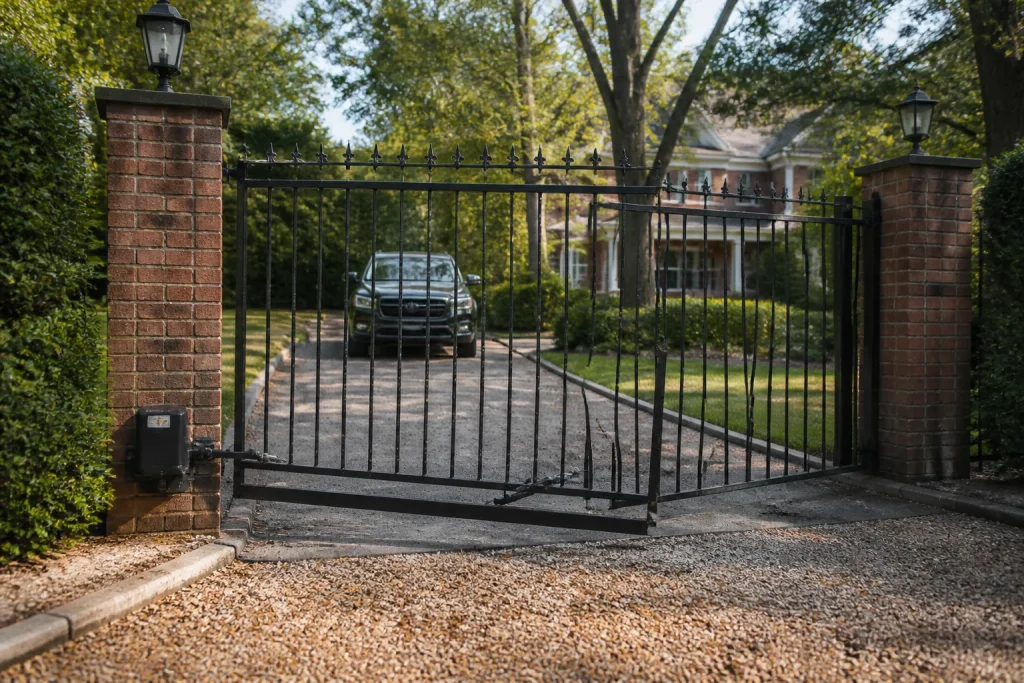
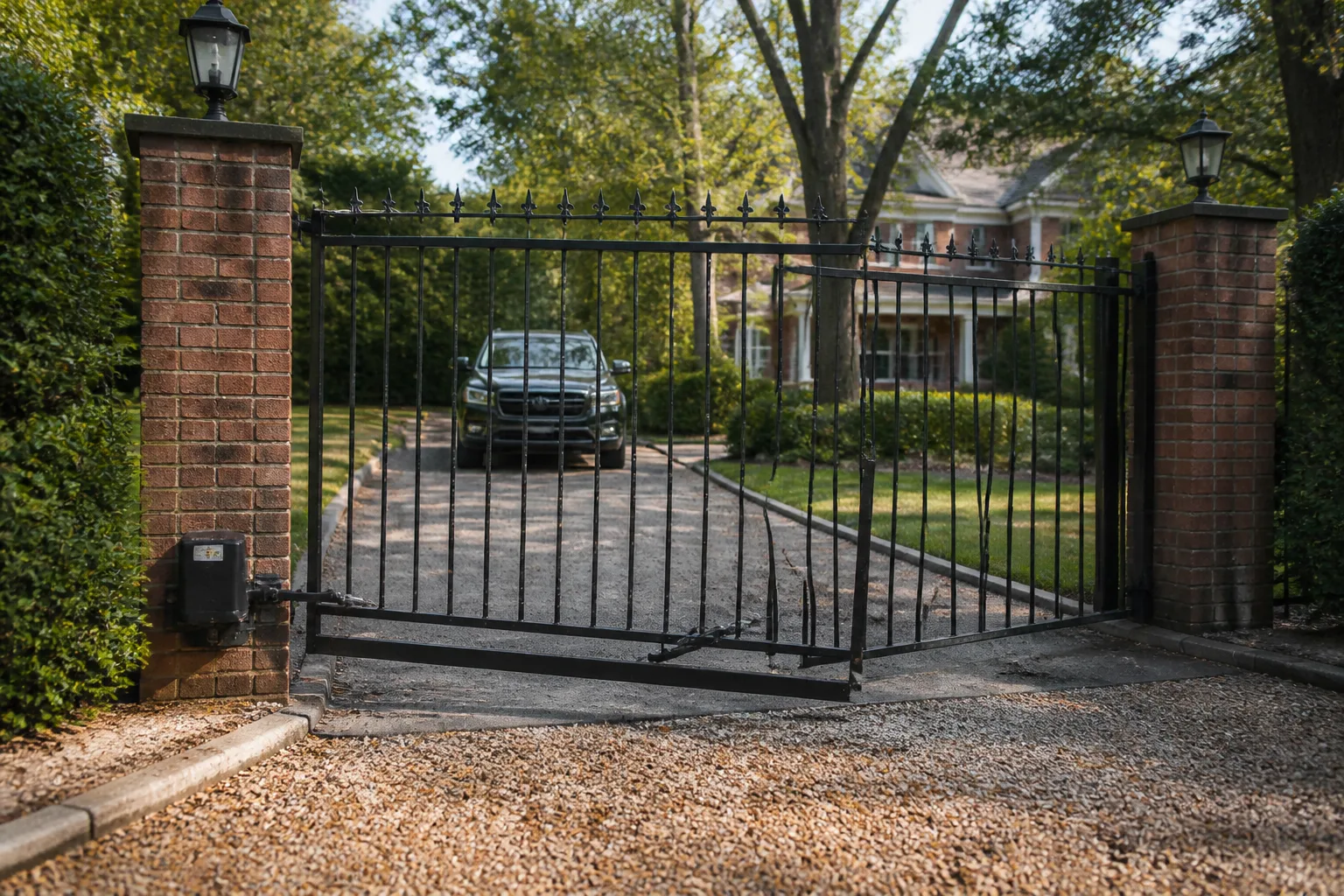
If the gate is stuck closed: don’t drive into it, don’t push it, and don’t ask someone to lift the arm by hand. Find the manual release (the exact location depends on the brand – more on that below), disengage the operator, and walk the gate open by hand with a second person spotting the swing path. If a vehicle is inside and needs out, that’s the sequence. If a person is pinned or a vehicle is sitting in the gate’s path with the gate still trying to move, stop reading and call 911 first.
How Do You Release the Operator Without Damaging It?
Manual release is designed to be used – but only the right way, and only on a stopped operator. This is where most expensive emergency mistakes happen.
The release mechanism on a swing-arm operator is usually a lever or a keyed clutch on the arm itself. On a slide operator it’s typically a release handle or a chain pull on the housing. Underground operators vary more, and some require a keyed access cover above ground. The point is: find your release, don’t improvise one.
The pinch points that cause real damage are consistent across brands:
- Swing arm: the arm has to travel in an arc. Pull on the gate leaf instead of the arm, and you can bend the arm or strip the gear inside the operator.
- Slide rail: forcing a gate along the rail while the pinion is still engaged chews the rack. That’s a repair that starts at several hundred dollars and climbs from there.
- Underground operators: the release is inside the housing. Prying the cover or the gate itself is how covers get cracked and linkages get bent.
If you can’t find the release, or the release won’t move without real force, stop. Forcing it is how a $200 fix turns into a replacement. If you’re in Norfolk and stuck at that point, a quick call to our electric gate repair line can usually get a technician talking you through your specific brand’s release over the phone.
What Should You Tell the Repair Company When You Call?
Four pieces of information let a technician arrive with the right parts instead of making a diagnostic-only first trip. Have these ready before you dial:
- The brand and model of the operator. Look on the housing – most have a data plate. Viking, Ghost Controls, DoorKing, and Elite all sit on that plate differently, but if you tell us the name we can work from there.
- What the gate is doing right now. Stuck open, stuck closed, reversing mid-travel, running but not moving, or dead with no lights on the board. That last one often points at power or a fuse rather than the motor.
- Gate type and size. Swing or slide, single or double leaf, roughly how wide. A slide gate behaves nothing like a swing gate under fault.
- Whether you’ve already tried a manual release, and what happened. If the release moved cleanly and the gate swings freely, that’s a very different call than “the arm won’t budge.”
Those four answers are the difference between a technician showing up prepared and a technician showing up to look. We work with LiftMaster, FAAC, BFT, Linear, and Mighty Mule systems as well as the four above, so if you can name the brand, we’ve likely seen the control board before.
When you’re ready to book, call (844) 410-6351. We answer 24/7. Fast dispatch from 7am to 7pm, Sunday through Friday. If you call outside those dispatch hours, we’ll book you into the next opening.
Why Do Gate Failures Spike After a Storm in Norfolk?
Post-storm gate failures aren’t really about wind hitting the gate. They’re about what wind leaves behind – branches in the track, debris against a safety edge, and water getting into housings that were never meant to sit wet.
After a storm in Norfolk, we field a wave of calls that all sound similar:
- A slide gate that won’t close because a twig is sitting in the rack.
- A swing gate that keeps reversing because the safety loop is detecting something that isn’t there, or debris is fouling the photocell beam.
- An operator that trips a breaker because water got into the housing.
The realistic temporary measures while you wait for a technician during a peak-demand period are simple and physical: clear the track by hand, chain the gate shut if you can, and park a vehicle across the opening. Don’t keep cycling the gate trying to “clear” the fault. Every failed cycle adds wear to the motor and the control board. If the gate is on a schedule for your HOA or a commercial lot, call in the fault the moment you see it and mark the gate as out of service so nobody else tries it.
The One Situation Where You Should Not Touch the Gate
If a vehicle is sitting in the gate’s path with the gate still trying to move, or a person has any part of their body under, in, or inside the gate’s swing or slide area, call 911. Do not attempt a manual release. Do not try to lift the arm, lift the gate, or drive the vehicle out. Entrapment involving a safety loop or a vehicle caught in the gate path is an emergency-services situation, not a repair.
The same goes for a gate that has come off its track or its rail with a vehicle or person nearby. A heavy leaf that’s off the rail can drop. That’s not a job for hands.
For everything short of that – a gate stuck, a motor that’s dead, an operator that’s tripping – a technician is the right call. Our technicians have up to 9 years of experience with the actual control boards and logic systems of the brands you already own, so the fix is usually right the first time.
When to Call a Pro (and When DIY Is Fine)
Clearing a branch from a track, checking a fuse, or finding your operator’s manual release – those are fine to do yourself. Anything involving opening an operator housing, testing control-board voltages, or adjusting safety-edge alignment is not. Gates are heavy, the operators carry real electrical current, and the pinch points are unforgiving.
If your gate is more than a debris-clear, we’d rather you call. A quick diagnosis saves you the cost of a mistake that compounds a repair.
Related services in Norfolk: if the fault is in the operator or the wiring, that’s electric gate repair. If it’s a mechanical fault – a bent arm, a released rail, a damaged hinge – that’s gate repair. And if you’re ready to replace the gate entirely, we handle installation too. More on the full picture of Gate Repair Norfolk.
The Bottom Line
The first fifteen minutes after a gate failure decide how much it costs you in money and security. Stuck open: secure the opening, engage the manual release, add a physical deterrent. Stuck closed: find the release, don’t force it, keep hands and vehicles out of the path. Always know your brand and have the four call-in details ready. And if a person or vehicle is caught in the gate’s path with the gate still moving, call 911 before anything else.
If you’re in Norfolk and need help, Gate Repair Norfolk offers free estimates. Call (844) 410-6351. We answer 24/7. Fast dispatch from 7am to 7pm, Sunday through Friday.
Frequently Asked Questions
We can’t quote a number over the phone, and any company that does is guessing. The price is set per job by the written estimate, which you approve before any work starts. That estimate covers the diagnostic, the parts, and the labor. The written estimate is the price – no surprises at the end.
Often, yes. We answer 24/7 and fast dispatch runs from 7am to 7pm, Sunday through Friday. If you call outside dispatch hours, we book you into the next opening. Same-day service is common for the calls we get in Norfolk, though it depends on how many other customers are waiting on a storm-heavy day.
Call anyway. We work on nine brands – LiftMaster, FAAC, BFT, Linear, Viking, Ghost Controls, DoorKing, Elite, and Mighty Mule – but brand-specific diagnostics is what we do, and a technician can usually tell you on the phone whether your brand is one we can help with. If it isn’t, we’ll say so.
No. If the release won’t move without real force, stop. Forcing it bends the arm, strips the gear, or chews the rack, and that turns a quick repair into a replacement. If you can’t get it to move, call (844) 410-6351 and we’ll talk you through your brand’s release.
Written by the team at Gate Repair Norfolk.
Need Gate Repair Help?
Call Gate Repair Norfolk - licensed & insured, here with fast help in Norfolk.
(844) 410-6351